
Prompt Engineering Skills
A Complete Step-by-Step Guide for Professionals
Prompt engineering skills have rapidly become one of the most valuable competencies in the modern AI-driven workplace. As organizations adopt large language models (LLMs) like GPT, Claude, and Gemini, the ability to communicate effectively with these systems is no longer optional—it is a strategic advantage. Prompt engineering sits at the intersection of communication, logic, domain expertise, and systems thinking, transforming how humans collaborate with machines.
This article provides a comprehensive, professional, step-by-step guide to developing strong prompt engineering skills. Drawing from real-world platform experience, it breaks down the concepts, techniques, and best practices required to design prompts that are reliable, scalable, and production-ready. Whether you are a developer, product manager, data analyst, marketer, or technical writer, mastering prompt engineering will significantly amplify your impac
Understanding Prompt Engineering Skills
Prompt engineering skills refer to the ability to design, structure, and refine inputs (prompts) that guide AI models toward producing accurate, useful, and contextually appropriate outputs. Unlike traditional programming, prompt engineering relies on natural language, yet it demands precision, logic, and a deep understanding of how models interpret instructions.
At a high level, prompt engineering involves:
- Translating human intent into machine-understandable instructions
- Controlling tone, format, and depth of responses
- Reducing ambiguity and hallucinations
- Optimizing outputs for specific use cases
Professionals with strong prompt engineering skills understand that prompts are not casual questions. They are structured interfaces between humans and probabilistic systems. Small changes in wording, order, or constraints can significantly alter the results.
From a business perspective, prompt engineering skills enable:
- Faster automation of complex workflows
- Consistent AI outputs at scale
- Reduced operational costs
- Higher trust in AI-generated content
As AI tools evolve, prompt engineering is becoming a core digital literacy skill—much like how spreadsheets once revolutionized office work.
Why Prompt Engineering Skills Matter in 2026 and Beyond
The importance of prompt engineering skills has grown in parallel with the capabilities of modern language models. These models are no longer experimental tools; they are embedded in customer support systems, content pipelines, data analysis workflows, and internal knowledge platforms.
Several factors explain why prompt engineering skills are now mission-critical:
- Model power is increasing faster than usability
Advanced models can perform remarkable tasks, but only when guided correctly. - AI outputs influence real decisions.
Poorly designed prompts can lead to biased insights, incorrect summaries, or misleading recommendations. - Organizations demand repeatability
Prompt engineering ensures outputs are consistent, auditable, and aligned with business goals. - Human oversight remains essential.
Prompt engineers act as interpreters, aligning AI behavior with human intent.
In practice, professionals with strong prompt engineering skills become force multipliers. They extract more value from the same AI tools, often outperforming teams with access to superior models but weaker prompting strategies.
The Core Components of Prompt Engineering Skills
Prompt engineering skills are not a single ability; they are a layered skill set composed of multiple competencies. Understanding these components helps professionals identify where to focus their improvement efforts.
Linguistic Precision
The ability to choose words that minimize ambiguity and guide the model effectively.
Instructional Design
Step-by-step structuring of prompts to control reasoning, output format, and constraints.
Context Management
Providing just enough background information without overwhelming the model.
Logical Framing
Breaking complex tasks into smaller, sequential steps.
Evaluation and Iteration
Testing outputs, identifying weaknesses, and refining prompts systematically.
Together, these components transform prompt writing from trial-and-error into a disciplined engineering practice.
Step 1: Defining Clear Objectives
Every successful prompt begins with a clearly defined objective. One of the most common mistakes beginners make is asking vague or multi-purpose questions. Strong prompt engineering skills start with clarity of intent.
Before writing a prompt, professionals ask:
- What exact outcome do I want?
- Who is the intended audience?
- How will the output be used?
- What level of depth or accuracy is required?
For example, “Explain prompt engineering” is an unfocused request. In contrast, “Explain prompt engineering to junior software engineers using practical examples and a formal tone” provides direction, scope, and audience.
Clear objectives allow you to:
- Reduce unnecessary output
- Improve relevance
- Save time on revisions.
- Achieve consistent results
Defining objectives is not optional—it is the foundation of effective prompting.
Step 2: Structuring Prompts for Reliability
Once the objective is clear, the next step is structuring the prompt in a way that aligns with how language models process information. Prompt engineering skills involve understanding that models respond better to structured inputs than free-form questions.
A reliable prompt structure often includes:
- Role assignment (e.g., “Act as a senior data analyst”)
- Task description (what the model should do)
- Constraints (length, tone, format, limitations)
- Output format (bullet points, table, code, summary)
This structure reduces uncertainty and improves output quality.
For example:
- Poor structure: “Write about AI ethics.”
- Strong structure: “Act as an AI policy advisor. Write a 600-word article on AI ethics for business leaders, using clear headings and real-world examples.”
Professional prompt engineers treat the structure as non-negotiable. It transforms AI from a creative guesser into a dependable collaborator.
Step 3: Using Context Strategically
Context is a powerful tool—but too much context can be just as harmful as too little. One of the most overlooked prompt engineering skills is knowing how much background information to provide.
Effective context includes:
- Relevant background information
- Definitions of key terms
- Assumptions the model should follow
- Boundaries should not be crossed.
However, excessive context can:
- Dilute the main task
- Confuse priority signals
- Increase irrelevant outputs
The goal is contextual sufficiency. Provide only what the model needs to succeed. Professionals often test prompts with minimal context first, then incrementally add details as needed.
This disciplined approach separates experienced prompt engineers from casual users.
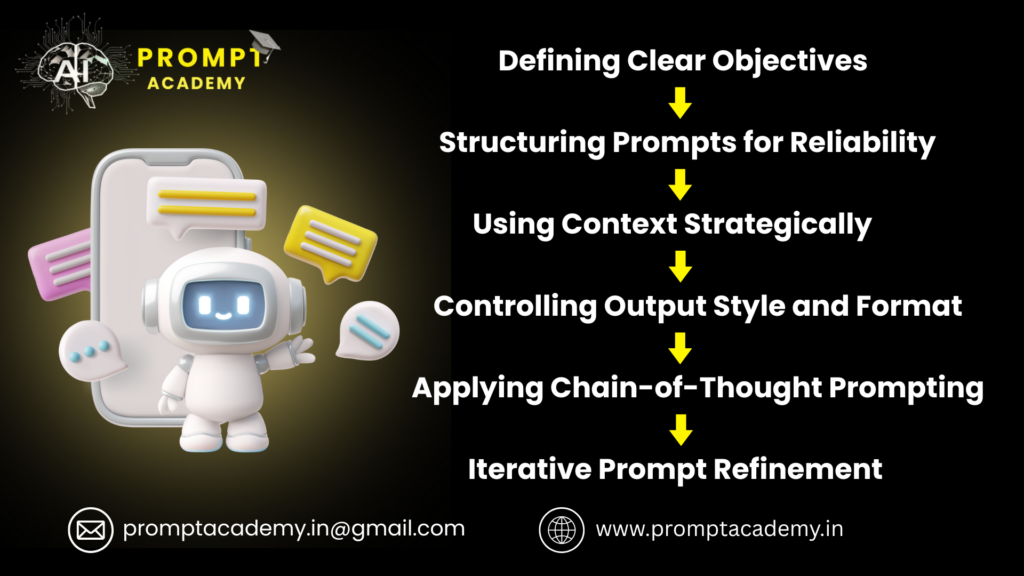
Step 4: Controlling Output Style and Format
Another critical prompt engineering skill is controlling how the output looks—not just what it says. Without explicit formatting instructions, models will choose defaults that may not suit professional use cases.
To control output effectively, specify:
- Tone (formal, conversational, technical)
- Length (word count, bullet limits)
- Structure (headings, lists, tables)
- Perspective (first person, third person)
For example:
- “Provide a concise executive summary in under 150 words.”
- “Use bullet points and avoid emojis.”
- “Write in neutral, professional language suitable for documentation.”
Professionals who master output control dramatically reduce post-editing time and improve downstream usability.
Step 5: Applying Chain-of-Thought Prompting
Chain-of-thought prompting is one of the most powerful advanced prompt engineering skills. It involves encouraging the model to reason step by step rather than jumping directly to an answer.
This technique is especially useful for:
- Complex problem-solving
- Logical analysis
- Multi-step decision-making
- Data interpretation
A simple way to apply it is by adding instructions such as:
- “Explain your reasoning step by step.”
- “Break down the process before giving the final answer.”
While not always necessary, chain-of-thought prompting significantly improves accuracy in complex tasks. Experienced prompt engineers use it selectively, balancing reasoning depth with efficiency.
Step 6: Iterative Prompt Refinement
Prompt engineering is an iterative discipline. Even well-designed prompts often require multiple rounds of refinement. Strong prompt engineering skills include the ability to evaluate outputs critically and make targeted improvements.
Key refinement questions include:
- Where did the output deviate from expectations?
- Was the issue ambiguity, missing context, or unclear constraints?
- Did the model misinterpret priority signals?
Instead of rewriting prompts entirely, professionals adjust:
- One instruction at a time
- The order of instructions
- Specific wording that caused confusion
This systematic iteration leads to stable, high-performing prompts that can be reused and scaled.
Common Mistakes That Weaken Prompt Engineering Skills
Even experienced users fall into predictable traps. Recognizing these mistakes accelerates skill development.
Common pitfalls include:
- Overloading prompts with multiple tasks
- Using vague language like “talk about” or “discuss.”
- Assuming the model understands unstated preferences
- Ignoring output evaluation
- Treating prompts as disposable rather than assets
Avoiding these mistakes requires discipline, not complexity. The best prompt engineers value clarity over cleverness.
Prompt Engineering Skills Across Professional Roles
Prompt engineering skills are not limited to technical roles. Their applications span multiple domains.
For Developers
- Generating clean, documented code
- Debugging and refactoring
- Writing test cases
For Product Managers
- Drafting requirements
- Summarizing user feedback
- Exploring feature trade-offs
For Marketers
- Creating campaign drafts
- A/B testing messaging
- Generating SEO content
For Analysts
- Interpreting datasets
- Explaining trends
- Creating executive summaries
The versatility of prompt engineering skills makes them universally valuable.
Measuring Prompt Engineering Effectiveness
Professional environments require measurable outcomes. Prompt engineering skills should be evaluated using clear criteria.
Common evaluation metrics include:
- Accuracy of outputs
- Consistency across runs
- Reduction in manual edits
- Time saved per task
- User satisfaction
By treating prompts as performance assets, organizations can continuously improve AI reliability.
Building a Prompt Engineering Skillset Long-Term
Developing strong prompt engineering skills is a continuous process. Models evolve, capabilities expand, and best practices shift.
To stay effective:
- Regularly test new prompting techniques
- Maintain a prompt library.
- Document successful patterns
- Share learnings across teams.
Prompt engineering is not a one-time skill—it is a professional discipline.
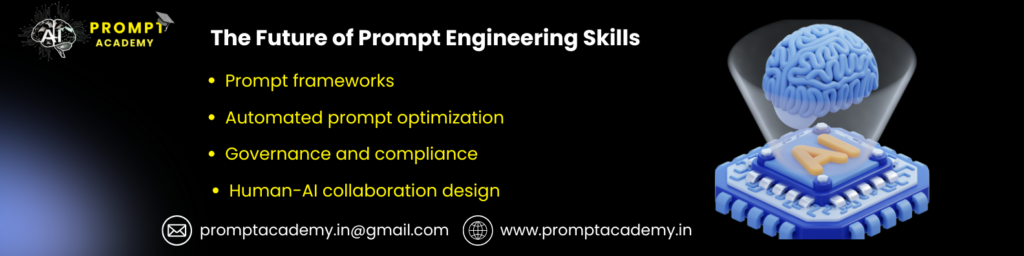
The Future of Prompt Engineering Skills
As AI systems become more capable, prompt engineering skills will move from tactical execution to strategic design. Future professionals will focus on:
- Prompt frameworks
- Automated prompt optimization
- Governance and compliance
- Human-AI collaboration design
Those who invest early will shape how AI is used responsibly and effectively.
Conclusion
Prompt engineering skills are no longer optional—they are essential for anyone working with modern AI systems. From defining objectives and structuring prompts to refining outputs and scaling success, prompt engineering transforms AI from a novelty into a dependable professional tool.
By approaching prompt engineering as a disciplined, step-by-step practice, professionals can unlock consistent, high-quality results across roles and industries. The future belongs to those who can communicate clearly—not just with people, but with intelligent machines.
FAQ,s
1. Are prompt engineering skills only useful for developers?
No. Prompt engineering skills are valuable across marketing, analytics, product management, writing, and leadership roles.
2. How long does it take to become proficient in prompt engineering?
Basic proficiency can be achieved quickly, but advanced mastery develops through ongoing practice and refinement.
3. Do prompt engineering skills replace programming?
No. They complement programming by enabling faster exploration, documentation, and automation.
4. Can prompt engineering reduce AI hallucinations?
Yes. Clear objectives, constraints, and structure significantly reduce inaccurate or fabricated outputs.
5. Will prompt engineering still matter as AI improves?
Yes. As models become more powerful, the ability to guide them precisely becomes even more critical.