
What Is Prompt Engineering Course
Introduction
Artificial intelligence has moved far beyond novelty tools and experimental chatbots. Today, AI systems power customer support platforms, generate marketing copy, write software code, analyze business data, and assist in strategic decision-making. At the heart of all these capabilities lies one critical skill that often goes unnoticed: prompt engineering.
A prompt is more than just a question typed into an AI interface. It is an instruction set, a structured conversation starter, and a control mechanism that determines how effectively an AI model understands intent and delivers results. This growing realization has led to the emergence of structured learning programs known as Prompt Engineering courses.
So, what is a Prompt Engineering course, and why has it become one of the most sought-after learning paths in the AI era? In simple terms, a Prompt Engineering course teaches you how to communicate with large language models in a precise, systematic, and optimized way. Instead of trial-and-error prompting, you learn repeatable frameworks that produce consistent, high-quality outputs.
As organizations increasingly rely on AI systems, the ability to guide those systems effectively becomes a professional advantage. This article explores the concept of a Prompt Engineering course in depth, breaking down what it includes, who it is for, how it is structured, and why it represents a powerful career investment in today’s AI-driven economy.
Understanding Prompt Engineering
What Prompt Engineering Really Means
Prompt engineering is the practice of designing, structuring, and refining inputs provided to AI models to achieve accurate, reliable, and context-aware outputs. While casual users may type a simple question and accept whatever response they receive, prompt engineers approach AI interaction with intention and strategy.
A well-engineered prompt considers multiple factors, including context length, instruction clarity, role definition, examples, constraints, and desired output format. Each of these elements influences how an AI model interprets the request and generates its response.
Prompt engineering is not about tricking AI systems. Instead, it is about aligning human intent with machine interpretation. Large language models do not “understand” information in the human sense. They predict responses based on patterns. A prompt engineer’s job is to guide that prediction process toward useful outcomes.
This discipline sits at the intersection of linguistics, logic, psychology, and computer science. It requires analytical thinking, creativity, and an understanding of how AI models process language. A Prompt Engineering course formalizes this knowledge, turning instinctive prompting into a structured, teachable skill.
Why Prompt Engineering Is a Critical Skill
The importance of prompt engineering becomes obvious when you compare two users interacting with the same AI model. One receives vague, inconsistent results. The other consistently generates detailed, accurate, and actionable outputs. The difference is not the AI—it is the prompt.
In professional environments, poor prompting leads to wasted time, unreliable data, and flawed decisions. Effective prompting, on the other hand, increases efficiency, improves accuracy, and reduces the need for manual corrections. This is why companies are now actively seeking professionals who understand prompt engineering principles.
A Prompt Engineering course teaches you how to:
- Reduce ambiguity in AI responses
- Control tone, structure, and depth of outputs
- Improve repeatability and scalability.
- Align AI outputs with business or technical goals.
As AI systems become embedded into daily workflows, prompt engineering evolves from a niche skill into a foundational competency.
Evolution of Prompt Engineering
From Simple Prompts to Advanced Systems
In the early days of AI chat interfaces, prompts were informal and conversational. Users typed short questions and received short answers. As language models grew more powerful, so did the complexity of interactions.
Prompt engineering evolved alongside these advancements. Simple prompts gave way to structured instructions, role-based prompts, and multi-step reasoning frameworks. Techniques such as chain-of-thought prompting allowed users to guide AI through logical reasoning steps rather than asking for final answers outright.
Modern prompt engineering now includes:
- Multi-prompt workflows
- Context stacking
- Dynamic prompt generation
- Prompt templates for automation
A Prompt Engineering course traces this evolution and teaches learners how to apply both foundational and advanced methods depending on the use case.
Prompt Engineering in the AI Lifecycle
Prompt engineering plays a role throughout the AI lifecycle, not just during user interaction. It influences model evaluation, testing, deployment, and optimization.
During development, prompts help test model capabilities and limitations. During deployment, they define how end users experience the system. During optimization, prompts are refined to improve accuracy, speed, and cost efficiency.
This broader perspective is a key component of professional Prompt Engineering courses. Learners are trained to think beyond individual prompts and consider system-level design.
What Is a Prompt Engineering Course
Formal Definition of a Prompt Engineering Course
A Prompt Engineering course is a structured educational program designed to teach individuals how to design, test, refine, and optimize prompts for AI language models. These courses combine theoretical foundations with practical, hands-on exercises.
Unlike generic AI courses, Prompt Engineering courses focus specifically on human-AI interaction. They emphasize practical outcomes, such as generating reliable content, automating workflows, and improving AI-driven decision-making.
Most courses include:
- Conceptual frameworks
- Real-world examples
- Practical assignments
- Tool-based learning
The goal is not just knowledge acquisition but skill mastery.
Who Should Take a Prompt Engineering Course
Prompt Engineering courses are not limited to technical professionals. They are designed for a wide audience, including:
- Software developers seeking better AI integration
- Content creators aiming for consistent outputs
- Marketers optimizing AI-generated campaigns
- Business leaders using AI for strategy
- Students preparing for AI-driven careers
Because prompt engineering focuses on communication rather than coding alone, it is accessible to both technical and non-technical learners.
Core Topics Covered in a Prompt Engineering Course
A professional Prompt Engineering course is carefully structured to move learners from basic concepts to advanced, real-world applications. Rather than focusing on abstract theory alone, these courses emphasize practical skills that can be immediately applied across industries.
Foundational Concepts
The course usually begins with an explanation of how large language models work at a conceptual level. Learners do not need deep mathematical knowledge, but they must understand the mechanics that influence AI responses. Topics typically include how language models predict tokens, how context windows function, and how parameters such as temperature and top-p affect creativity and determinism.
Understanding these fundamentals helps learners make informed decisions when designing prompts. For example, knowing how context limits work allows you to decide how much information to include without overwhelming the model. This foundational knowledge transforms prompting from guesswork into a deliberate design process.
Key foundational concepts often include:
- How AI models interpret natural language
- Token limits and context management
- Deterministic vs creative outputs
- Bias and safety considerations
These basics form the backbone of all advanced prompt engineering techniques.
Prompt Design Techniques
Once the foundations are established, Prompt Engineering courses move into practical design strategies. Learners are introduced to different prompting methods and shown when to use each one effectively.
Common techniques taught include:
- Zero-shot prompting, where no examples are provided
- One-shot prompting, using a single example to guide output
- Few-shot prompting, leveraging multiple examples for accuracy
- Instruction-based prompting, where tasks are clearly defined
Through hands-on exercises, learners see how small changes in wording or structure can dramatically change AI behavior. This part of the course emphasizes clarity, precision, and intentional design.
Advanced Prompting Methods
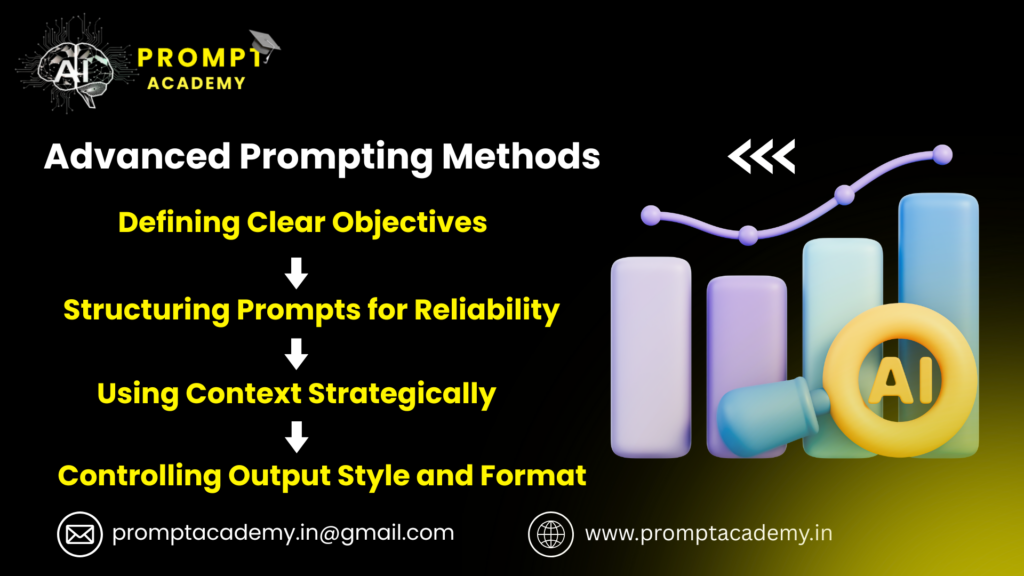
Advanced modules focus on techniques used by experienced practitioners. These methods are essential for complex workflows and enterprise-level applications.
Advanced topics often include:
- Chain-of-thought prompting for reasoning tasks
- Role prompting to define AI behavior
- Self-consistency prompting to improve accuracy.
- Prompt chaining for multi-step processes
These techniques allow learners to break complex problems into manageable steps, increasing reliability and reducing errors. A strong Prompt Engineering course ensures learners understand not just how to use these methods, but why they work.
Prompt Engineering Platforms and Tools
Prompt Engineering courses rely heavily on hands-on practice, and this requires access to reliable platforms and tools.
Popular Platforms Used in Courses
Most courses introduce learners to widely used prompt experimentation environments. These platforms allow users to test, refine, and compare prompts in real time.
Commonly used tools include:
- Interactive AI playgrounds
- Prompt Engineering platforms with version control
- API-based testing environments
These tools help learners understand how prompts behave across different settings and configurations. Exposure to multiple platforms ensures skills remain transferable.
Hands-On Learning Environments
High-quality Prompt Engineering courses emphasize experimentation. Learners are encouraged to test assumptions, document results, and iterate on prompt designs.
Hands-on environments typically offer:
- Prompt testing sandboxes
- Output comparison tools
- Performance evaluation metrics
This practical focus ensures learners gain confidence and develop intuition through real-world practice rather than passive learning.
Technical Skills You Learn in a Prompt Engineering Course
Prompt Engineering courses teach a unique blend of technical and cognitive skills. These skills extend beyond AI usage and improve overall problem-solving abilities.
Prompt Structuring and Optimization
Learners develop the ability to structure prompts logically and optimize them for clarity and consistency. This includes breaking tasks into steps, defining constraints, and specifying output formats.
Debugging and Iteration Techniques
Just like software code, prompts require debugging. Courses teach learners how to identify failure points, test variations, and refine prompts based on output behavior.
Prompt Versioning and Documentation
Professional environments require consistency. Prompt Engineering courses often teach how to document prompts, track versions, and standardize usage across teams.
Business and Creative Applications
One of the strongest advantages of a Prompt Engineering course is its versatility across industries.
Prompt Engineering for Content Creation
Writers, marketers, and media professionals use prompt engineering to generate articles, scripts, emails, and social content efficiently while maintaining quality and brand consistency.
Prompt Engineering for Software Development
Developers leverage prompts for code generation, debugging, documentation, and testing. Well-designed prompts significantly improve accuracy and reduce rework.
Prompt Engineering for Marketing and Sales
In marketing and sales, prompt engineering helps personalize messaging, analyze customer data, and generate insights at scale.
Enterprise Use Cases
Large organizations increasingly rely on prompt engineering to scale AI usage safely and effectively.
Automation and Workflow Optimization
Prompt engineering enables automation of repetitive tasks, freeing teams to focus on higher-value work.
Customer Support and Chatbots
Well-engineered prompts ensure chatbots provide accurate, empathetic, and consistent responses.
Data Analysis and Decision Support
Prompt engineering allows business users to query complex datasets using natural language, making insights more accessible.
Course Formats and Learning Paths
Prompt Engineering courses are available in multiple formats to suit different learning preferences.
Self-Paced Courses
Ideal for independent learners who prefer flexibility.
Instructor-Led Programs
Provide structure, mentorship, and feedback.
Bootcamps and Certifications
Intensive programs designed for rapid skill acquisition and career transitions.
How to Choose the Right Prompt Engineering Course
Selecting the right course is essential for maximizing value.
Key evaluation criteria include:
- Practical, hands-on focus
- Real-world use cases
- Updated content aligned with current AI tools
- Clear learning outcomes
Red flags include overly theoretical content, lack of exercises, or vague curriculum descriptions.

Career Opportunities After a Prompt Engineering Course
Completing a Prompt Engineering course opens doors to new roles and career paths.
Prompt Engineer
Specialists responsible for designing and optimizing AI prompts.
AI Product Specialist
Professionals bridging technical and business teams.
Consultant and Trainer
Experts helping organizations adopt AI effectively.
Future of Prompt Engineering
Prompt engineering is evolving alongside AI automation. While some tasks may become automated, the ability to design, evaluate, and govern prompts will remain critical.
As AI systems become more autonomous, prompt engineering will shift toward system-level orchestration, governance, and ethical oversight. Learning this skill now positions professionals ahead of the curve.
Conclusion
So, what is a Prompt Engineering course? It is far more than a technical training program. It is a practical, future-focused learning experience that teaches individuals how to communicate effectively with AI systems. As AI continues to reshape industries, prompt engineering stands out as a foundational skill that blends logic, creativity, and strategic thinking.
For professionals seeking relevance, efficiency, and impact in an AI-driven world, a Prompt Engineering course is not just an option—it is an investment in long-term capability.
FAQ,s
1. Do I need a technical background to take a Prompt Engineering course?
No. Most courses are designed for both technical and non-technical learners.
2. How long does it take to learn prompt engineering?
Basic skills can be learned in weeks, while mastery develops through continuous practice.
3. Are Prompt Engineering courses useful for business professionals?
Yes. They are highly valuable for marketing, strategy, and operations roles.
4. Is prompt engineering a long-term career skill?
Yes. As AI adoption grows, prompt engineering remains essential for control and optimization.
5. Can prompt engineering replace programming?
No, but it complements programming and enhances productivity across technical and non-technical roles.