Prompt Academy is ideal for learners and professionals who want to use AI safely and effectively in cybersecurity. It helps build AI-driven defense skills, faster threat analysis, and smarter security workflows without heavy coding knowledge.

Prompt Engineering for Cyber Security
With
Certification & 100% Placement Assistance
Online & Classroom Training | 1-Month Structured Program | Hands-On Real-Time Projects
Our Prompt Engineering for Cyber Security program focuses on secure AI workflows, real-world cyber defense scenarios, and industry-relevant security use cases. It helps security professionals and learners detect threats faster, analyze vulnerabilities, automate incident response, improve SOC efficiency, and build strong career opportunities in the cybersecurity domain.
Batch Details
Details | Information |
Trainer Name | Ms. Pushkara Seelam |
Trainer Experience | 3+ Years of Real-Time Industry Experience |
Next Batch Date | 11 December 2025 |
Training Modes | Online & Offline Training |
Course Duration | 1 Month |
Call Us At | +91 81868 44555 |
Email Us At | promptacademy.in@gmail.com |
Demo Class Details | Enroll for Free Demo Class |
Menu
Prompt Engineering Course in Hyderabad
Course Curriculum
1. What is prompt engineering in cybersecurity
Prompt engineering teaches how to guide AI systems to analyze threats, generate alerts, and support cybersecurity workflows accurately.
2. Why is prompt engineering important for cybersecurity
It improves AI accuracy in threat detection, log analysis, and incident response by reducing ambiguity in security prompts.
3. How does AI assist cybersecurity operations
AI supports vulnerability analysis, threat classification, and automated responses using well-structured security prompts.
4. What skills are needed to learn ccybersecurityprompting
Basic cybersecurity concepts, logical thinking, and clear communication skills are enough to start learning effectively.
5. How are prompts used in threat detection
Prompts instruct AI to analyze logs, detect anomalies, and identify patterns linked to malware or intrusions.
6. Can prompts help with vulnerability assessment
Yes, prompts guide AI to scan reports, summarize risks, and recommend mitigation strategies clearly.
7. How does prompt engineering support incident response
It helps generate step-by-step response plans, containment actions, and incident summaries for faster recovery.
8. Are prompts useful for SOC teams
SOC teams use prompts to prioritize alerts, analyze events, and create concise security reports.
9.How are prompts used in malware analysis
Prompts help AI explain malware behavior, indicators of compromise, and potential impact in simple terms.
10. Can prompt engineering assist in phishing detection
Yes, prompts train AI to identify suspicious emails, URLs, and social engineering patterns effectively.
11. How does prompt engineering improve log analysis
It enables AI to summarize large log files, highlight anomalies, and explain findings clearly.
12. Are coding skills required for this course
No coding is mandatory, but understanding scripts and logs helps improve prompt quality.
13. How are prompts used in security automation
Prompts guide AI to generate workflows, playbooks, and automated response suggestions.
14.Can prompts help with compliance reporting
Yes, AI prompts generate compliance summaries, audit checklists, and policy explanations.
15. How does prompt engineering reduce false positives
Clear prompts define context and constraints, helping AI filter noise and focus on real threats.
16. Is prompt engineering useful for cloud security
Prompts help analyze cloud logs, access policies, and misconfigurations across environments.
17. How are prompts used in risk assessment
AI prompts evaluate assets, threats, and vulnerabilities to generate clear risk scores.
18.Can prompts support security training
Yes, prompts create simulations, quizzes, and awareness content for cybersecurity teams.
19.What tools are used in cybersecurity prompting
AI platforms integrated with SIEM, SOC tools, and security analytics systems are commonly used.
20. Is prompt engineering a future ccybersecurityskill
Yes, as AI adoption grows, prompt engineering becomes essential for modern ccybersecurityroles.
Prompt Engineering Course Trainer Details
INSTRUCTOR
Ms. Pushkara Seelam
Expert & Lead Instructor
3+ Years Experience
About the Tutor:
Ms. Pushkara Seelam is a dedicated trainer for the Prompt Engineering Course, bringing over 3+ years of hands-on industry and training experience in AI-driven workflows and prompt design. She specializes in teaching how to communicate effectively with AI tools and large language models, helping learners build clarity and confidence in prompt engineering.
With a practical, project-oriented teaching approach, Ms. Pushkara ensures that students gain industry-relevant skills by working on real-world prompt engineering use cases. Her training covers foundational concepts, advanced prompt strategies, and applied AI workflows used in professional environments.
Beyond technical instruction, Ms. Pushkara actively supports learners with resume preparation, mock interviews, and career guidance, helping them transition smoothly into AI-focused roles and Generative AI career paths.
Prompt Engineering for Cyber Security
Why choose us?
- Industry-focused prompts designed for real cybersecurity use
- Learn AI prompts for threat analysis and risk detection.
- Practical training with real-world cybersecurity scenarios
- Beginner to advanced prompt frameworks for security teams
- AI-driven methods to reduce cyber threats and attacks
- Expert mentors with cybersecurity and AI experience
- Hands-on labs for SOC, audits, and incident response
- Prompt techniques for malware and phishing analysis
- Improve security decisions using AI-powered insights.
- Career-oriented curriculum aligned with cyber roles.
- Learn faster with structured and reusable prompt models.
- Use AI safely with security-focused prompt guidelines.
- Certification that adds value to cybersecurity careers
- Future-ready skills for AI-driven cyber defense roles
What is Prompt Engineering for Cyber Security
Prompt engineering for cyber security is the practice of writing clear, structured, and objective-driven instructions that help AI support security professionals across the entire cyber defense lifecycle. Instead of relying only on manual analysis, security teams use prompts to guide AI in producing accurate, contextual, and threat-ready outputs.
As AI-driven security becomes mainstream, prompt engineering is a must-have skill for cybersecurity professionals who want to stay proactive, data-informed, and resilient against evolving threats.
- Threat detection and attack pattern analysis
- Malware investigation and log analysis
- Incident response and SOC workflow automation
- Vulnerability assessment and risk reporting
- Security compliance and policy documentation
At Prompt Academy, we focus on prompt engineering specifically tailored for Cyber Security use cases, including real-world threat analysis, SOC operations, and defensive AI workflows.
Where Prompt Engineering Is Used in Cyber Security
Cyber Security Area | Where Prompt Engineering Is Used | Example Use Cases |
Threat Detection | Guiding AI to analyze logs and alerts | Prompt AI to identify unusual login attempts from server logs |
Incident Response | Creating step-by-step response actions | Generate an incident response plan for ransomware attacks |
Vulnerability Assessment | Analyzing system weaknesses | Ask AI to review scan reports and list critical vulnerabilities |
Malware Analysis | Understanding malicious code behavior | Explain what a suspicious script does in simple language |
Phishing Detection | Identifying phishing emails | Analyze email content to detect phishing indicators |
Security Monitoring | Summarizing SIEM alerts | Convert raw security alerts into readable summaries |
Risk Assessment | Evaluating business security risks | Generate risk scores based on asset and threat data |
Compliance & Audits | Checking policy compliance | Create audit checklists for ISO or GDPR compliance |
Security Awareness Training | Creating training content | Generate cyber safety training for employees |
Log Analysis | Filtering large log files | Extract only critical security events from logs |
Penetration Testing | Planning attack simulations | Generate ethical hacking test scenarios |
Cloud Security | Reviewing cloud configurations | Identify misconfigured cloud storage permissions |
Endpoint Security | Analyzing device threats | Detect abnormal activity on employee laptops |
Network Security | Traffic pattern analysis | Identify suspicious network traffic behavior |
Access Control | Reviewing permissions | Find users with excessive access privileges |
Fraud Detection | Monitoring suspicious transactions | Detect unusual payment or account behavior |
Patch Management | Prioritizing security patches | Recommend patches based on severity levels |
Digital Forensics | Investigating incidents | Reconstruct attack timelines from logs |
Policy Creation | Drafting security policies | Generate cybersecurity policies for organizations |
Threat Intelligence | Summarizing threat reports | Convert threat feeds into actionable insights |
Benefits ofPrompt Engineering for Cyber Security
Prompt Engineering for Cyber Security enables security teams to give precise instructions to AI systems for faster threat detection, log analysis, and incident response. By structuring prompts clearly, cybersecurity professionals can automate repetitive tasks, improve alert accuracy, and reduce response time. This approach enhances decision-making, supports proactive defense strategies, and strengthens overall security operations with intelligent AI assistance.
1.Threat Detection?
AI identifies suspicious activities faster using structured security prompts.
2. Incident Response Speed?
Prompts enable quicker analysis and action during security incidents.
3. Log Analysis Automation?
AI summarizes large security logs into meaningful insights.
4. Vulnerability Assessment?
Prompts help identify system weaknesses and risk patterns.
5. Security Alert Accuracy?
Well-defined prompts reduce false positives in alerts.
6.Malware Analysis Support?
AI explains malware behavior using guided prompts.
7. Compliance Monitoring?
Prompts assist in checking policy and regulatory compliance.
8. Threat Intelligence Insights?
AI extracts trends and intelligence from threat data.
9. Operational Efficiency?
Automates routine tasks, saving time for security teams.
Prompt Engineering for Cyber Security
Skills Developed After the Course
- Write secure prompts for real-time threat analysis.
- Design AI prompts for malware detection workflow.s
- Create prompts to analyze logs and security alerts.
- Build AI-driven incident response prompt strategies.
- Generate prompts for vulnerability assessment reports.
- Craft prompts to reduce false security alert noise
- Use prompts for phishing detection and email analysis.s
- Apply prompt logic for SOC automation tasks.
- Design compliance-focused security audit prompts
- Create prompts for risk analysis and mitigation plans.
- Improve AI accuracy using constraint-based prompting.g
- Develop ethical and secure AI usage prompt practices.
Prompt Engineering for Cyber Security
Certifications
Prompt Engineering for Cyber Security helps professionals use AI to detect threats, analyze logs, and automate responses. Prompt Academy certifications focus on practical, real-world security use cases
- Learn AI prompts to detect cyber threats faster.r
- Improve incident response using a structured AI prompt.s
- Analyze security logs efficiently with AI assistance.
- Gain industry-ready skills through Prompt Academy.
- Certifications boost credibility in cybersecurity roles.
Prompt Engineering for Cyber Security Fee & Offerings in Hyderabad
Course Fees & Offerings
Video Recording
- Lifetime video access
- Basic to advanced prompts
- 70+ recorded classes
- One capstone project
- Resume and interview support
- Placement assistance provided
- WhatsApp learning group
Class Room Training
- 1 month of classroom training
- Expert prompt engineering trainers
- Real-time prompt projects
- One-on-one mentor support
- Monthly mock interviews
- Resume building & interview guidance
- Soft skills & aptitude training
- Dedicated placement officer
- Commute support (offline batches)
- WhatsApp support group
Online Course
- Live interactive prompt classes
- 1 month duration
- Daily session recordings
- Real-time project environment from Day 1
- Weekly mock interviews
- Dedicated doubt-clearing sessions
- 50+ sample resumes access
- WhatsApp learning group
EMI Available for modes. (Classroom Training – Online Course )
Prompt Engineering Course In Hyderabad
Testimonials
“Prompt engineering training strengthened my cybersecurity analysis skills and improved threat detection using AI tools effectively.”

Rohit Sharma
“This course clarified how AI prompts enhance vulnerability assessment and reduce manual workload for teams.”

Vikram Reddy
“As a security professional, prompt engineering improved my phishing analysis and email threat investigation accuracy.”
Sandeep Kulkarni
“Learning prompt engineering helped me automate security reports and respond faster to incidents confidently daily.”

Ananya Iyer
“Prompt engineering knowledge helped me collaborate better with AI tools during penetration testing projects successfully.”

Arjun Mehta
“Prompt engineering skills boosted my SOC efficiency by generating accurate alerts and incident summaries quickly.”

Neha Kapoor
“Learning prompt engineering empowered me to extract clearer insights from security data using AI platforms.”

Manoj Patil
“This program enhanced my cyber investigations by creating structured prompts for log analysis tasks efficiently.”
prakash
“The training showed practical ways to use AI prompts for compliance checks and risk assessments.”

Pooja Nair
have A Look at us
We can help you achieve your professional goals
Our instructors are experts in Prompt Engineering for Software Development with years of hands-on experience working with LLMs. They are passionate about teaching developers how to use AI prompts to write better code, debug faster, and build real-world software applications efficiently.
Prompt Engineering for Cyber Security - Our Great Achievements
Active Students
0
+
Courses
0
+
Expert Trainers
0
+
Batches
0
+
Prompt Engineering for Cyber Security
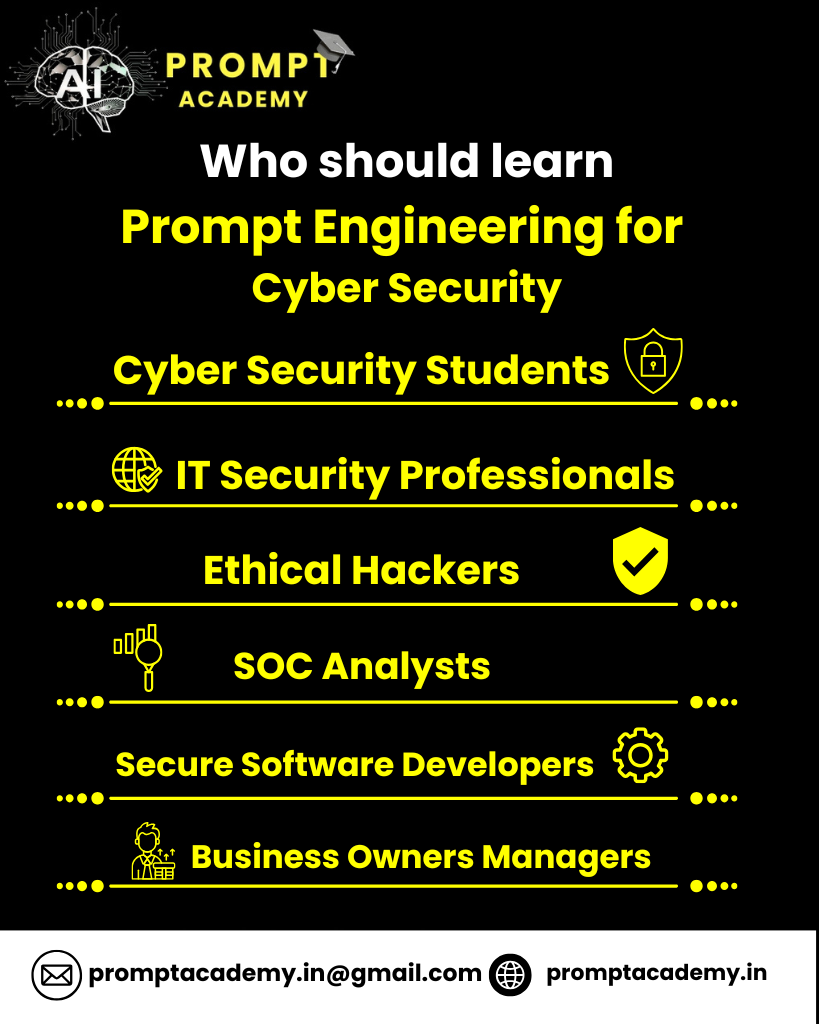
Who Should Join
- Cyber security students aiming to learn AI-powered threat detection, incident analysis, and modern defensive strategies.
- IT professionals want to enhance security operations using prompt engineering and AI-assisted risk analysis tools.
- Ethical hackers seek smarter ways to generate attack simulations, vulnerability reports, and penetration testing insights.
- SOC analysts looking to automate alerts, log analysis, and incident summaries using structured AI prompts.
- Developers interested in securing applications by combining prompt engineering with secure coding and threat modeling.
- Business owners and managers want AI-driven cyber awareness, compliance support, and faster security decision-making.
Prompt Engineering for Cyber Security
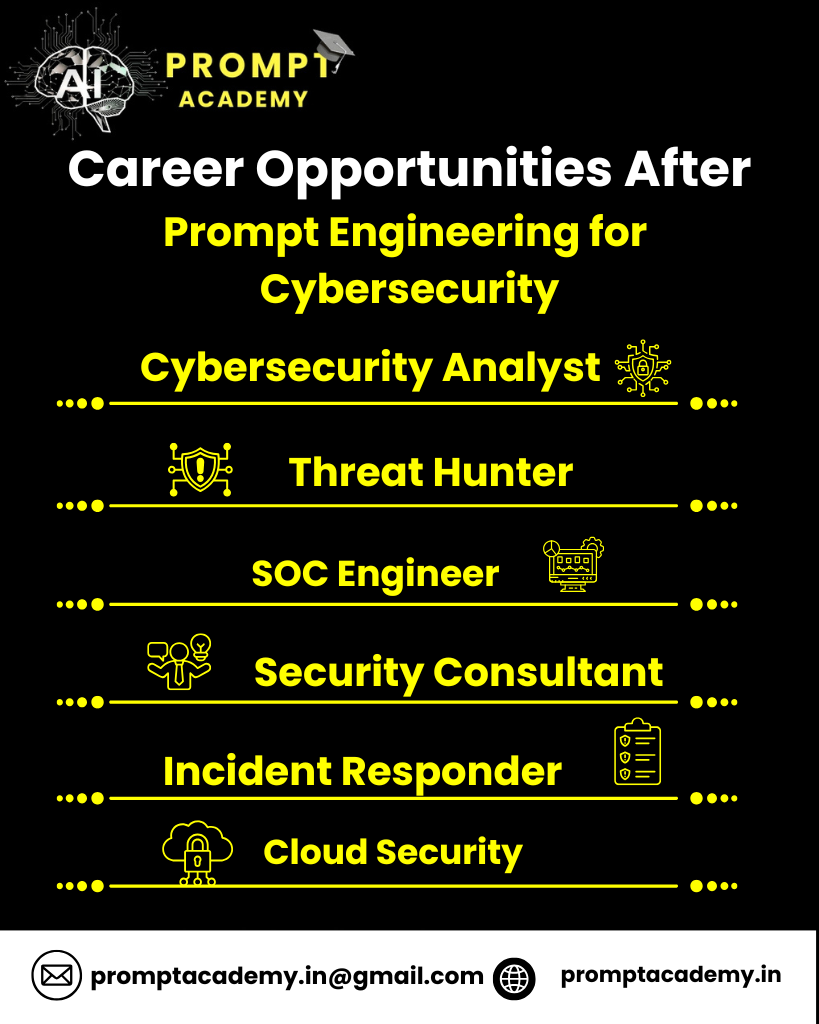
Careers Opportunities
- Cybersecurity prompt engineers design AI prompts to detect threats, analyze logs, and automate security monitoring systems.
- Security analysts use prompt engineering to investigate incidents faster and generate accurate threat intelligence reports.
- SOC professionals apply prompts to streamline alerts, reduce false positives, and improve response efficiency.
- Penetration testers use AI prompts to simulate attacks, analyze vulnerabilities, and generate remediation recommendations.
- Incident response engineers craft prompts to guide AI during breach analysis and recovery planning processes.
- Threat intelligence specialists leverage prompts to track attack patterns and predict emerging cyber threats.
- Compliance professionals use prompt engineering to automate audits, policy reviews, and regulatory reporting tasks.
- Cloud security engineers apply AI prompts to monitor configurations and identify misconfigurations across cloud environments.
- Security automation engineers design prompts that integrate AI into SIEM and SOAR workflows effectively.
- Cybersecurity consultants use prompt engineering to deliver faster assessments, insights, and strategic security recommendations.
Prompt Engineering for Cyber SecuritySalary in Hyderabad – Freshers to Experienced
Experience Level | Years of Experience | Average Salary Range (₹/Year) | Key Roles & Responsibilities |
Fresher | 0–1 Year | ₹4 L – ₹6.5 L | Write basic security prompts, assist SOC teams, automate alerts, and support threat analysis |
Junior | 1–3 Years | ₹6.5 L – ₹10 L | Optimize prompts for SIEM, phishing detection, log analysis, and incident response |
Mid-Level | 3–5 Years | ₹10 L – ₹16 L | Build advanced AI security workflows, threat modeling, prompt testing, and risk analysis |
Senior | 5–8 Years | ₹16 L – ₹24 L+ | Lead AI-driven security strategy, prompt governance, and automation architecture |
Expert / Lead | 8+ Years | ₹25 L – ₹40 L+ | Design enterprise AI security systems, policy controls, and zero-trust AI workflows |
FAQ,s
1. What is prompt engineering in cybersecurity?
It is the practice of writing precise AI instructions to analyze threats, generate alerts, and support security operations.
2. Why is prompt engineering important for cybersecurity?
It helps security teams use AI accurately for faster threat detection and reduced false alerts.
3. How does prompt engineering improve threat analysis?
Well-structured prompts guide AI to identify patterns, anomalies, and risks from security logs.
4.Can prompt engineering help incident response?
Yes, it assists in drafting response steps, investigation summaries, and mitigation recommendations.
5. Is coding required for prompt engineering?
No, it focuses on clear language, security context, and defined objectives rather than programming.
6. Who should learn prompt engineering in security?
SOC analysts, security engineers, CISOs, and IT administrators benefit from prompt skills.
7.Can prompt engineering reduce false positives?
Yes, refined prompts improve AI accuracy, lowering noise and irrelevant security alerts.
8. How does prompt engineering support vulnerability assessment?
It helps analyze scan results, prioritize risks, and explain vulnerabilities in simple terms.
9. Is prompt engineering useful for malware analysis?
Yes, prompts can summarize malware behavior, indicators, and potential impact quickly.
10. Can prompts help with security reporting?
They generate incident reports, compliance summaries, and audit documentation efficiently.
11. Is prompt engineering safe for sensitive data?
Yes, when prompts avoid sharing confidential data and follow security usage guidelines.
12. How long does it take to learn prompt engineering?
Basic skills can be learned in days, while expertise improves through real security use cases.
13.Does prompt engineering replace security professionals?
No, it supports professionals by automating analysis while humans make final decisions.
14. Can prompt engineering assist SOC operations?
It helps triage alerts, explain logs, and guide response actions for SOC teams.
15.How does prompt engineering improve productivity?
It speeds analysis, reduces manual effort, and allows teams to focus on critical threats.
16. Is prompt engineering useful for compliance tasks?
Yes, it helps summarize policies, map controls, and prepare audit-ready documentation.
17.Can prompts help train security teams?
They generate scenarios, quizzes, and explanations to improve security awareness.
18. Is prompt engineering scalable in enterprises?
Yes, it adapts across tools, teams, and growing security infrastructures.
19. What skills support effective security prompts?
Security fundamentals, analytical thinking, clarity, and understanding of threats improve results.
20.Is prompt engineering future-proof in cybersecurity?
Yes, as AI-driven security grows, prompt skills become essential for modern defense.

Prompt engineering for Software Developers Tools

Prompt engineering for Software Developers Prompt Templates