
Prompt Engineering vs Generative AI
Introduction
If you’ve spent any time around modern technology discussions lately, you’ve probably noticed two terms dominating conversations: Generative AI and Prompt Engineering. They’re often mentioned together, sometimes used interchangeably, and frequently misunderstood. This confusion has created a growing need for clarity, especially for professionals, developers, content creators, and business leaders trying to understand where value truly lies.
The keyword prompt engineering vs generative AI isn’t about choosing one over the other. Instead, it’s about understanding how they differ, how they complement each other, and why both are essential in today’s AI-driven ecosystem. Generative AI is the engine—the powerful system capable of creating text, images, code, and more. Prompt engineering is the steering wheel—the method that directs that power toward useful, accurate, and reliable outcomes.
This article takes a step-by-step, professional approach to breaking down both concepts. We’ll explore how Generative AI works, what prompt engineering actually involves, why prompt engineering has become a high-value skill, and how platforms dedicated to prompt engineering are shaping the future. Whether you’re technical or non-technical, this guide is designed to give you a practical understanding without unnecessary jargon.
By the end, you won’t just know the difference between prompt engineering and generative AI—you’ll understand why mastering both is quickly becoming a competitive advantage.
Understanding Generative AI
Generative AI refers to a category of artificial intelligence systems designed to create new content rather than simply analyze or classify existing data. Unlike traditional AI models that focus on prediction or pattern recognition, Generative AI produces original outputs such as text, images, audio, video, and even software code.
At its core, Generative AI learns from massive datasets. These datasets include books, articles, conversations, images, and structured information. Through training, the model learns patterns, relationships, and probabilities. When prompted, it doesn’t “think” like a human—it predicts what comes next based on learned patterns.
What makes Generative AI revolutionary is its versatility. A single model can:
- Write blog posts and marketing copy
- Generate programming code
- Summarize complex documents
- Answer technical questions
- Simulate conversations
- Create visual designs
However, Generative AI also has limitations. It doesn’t understand context the way humans do. It doesn’t verify truth. It doesn’t know intent unless it’s clearly guided. This is where many people get frustrated—because without proper direction, the output can be vague, inaccurate, or misleading.
Understanding Generative AI means recognizing both its power and its dependency. It’s an incredibly capable system, but it requires structured input to perform at its best. That dependency is precisely why prompt engineering exists and why the comparison of prompt engineering vs generative AI is so important.
How Generative AI Works Under the Hood
To truly grasp the difference between prompt engineering and generative AI, it helps to understand how Generative AI actually functions behind the scenes. While the math and architecture are complex, the concept itself can be explained simply.
Generative AI models, especially large language models, rely on neural networks with billions of parameters. These parameters are adjusted during training using vast datasets. The model learns how words, phrases, and concepts relate to one another based on probability. When you input a prompt, the model predicts the most likely next token, then the next, and so on.
Here’s what Generative AI does not do:
- It does not reason independently
- It does not fact-check itself.
- It does not understand goals unless state.d
Instead, it responds based on patterns. If the prompt is unclear, the output reflects that ambiguity. If the prompt lacks constraints, the response may drift. This is why two users can ask similar questions and receive wildly different results.
Generative AI is reactive, not proactive. It responds to input. That input—the prompt—is the single most important factor influencing output quality. This technical reality sets the stage for prompt engineering as a discipline.
In short, Generative AI is powerful but directionless without guidance. Prompt engineering provides that guidance.
What Is Prompt Engineering?
Prompt engineering is the practice of designing, structuring, and refining inputs to Generative AI systems to achieve desired outputs. While it may look simple on the surface—just typing instructions—it’s actually a nuanced technical skill.
A prompt isn’t just a question. It’s a set of instructions that can include:
- Context
- Role definition
- Constraints
- Output format
- Examples
- Step-by-step reasoning instructions
Prompt engineering focuses on clarity, specificity, and control. The goal is to reduce ambiguity and guide the AI toward predictable, useful responses. A well-engineered prompt can dramatically improve accuracy, relevance, and consistency.
For example, compare these two prompts:
- “Explain cloud computing.”
- Act as a cloud solutions architect. Explain cloud computing to a non-technical executive in under 200 words, using real-world analogies.”
The difference in output quality is significant. That improvement doesn’t come from the AI model changing—it comes from better prompting.
Prompt engineering transforms Generative AI from a general-purpose tool into a specialized assistant. This distinction is at the heart of the prompt engineering vs generative AI discussion.
The Evolution of Prompt Engineering
In the early days of Generative AI tools, prompts were simple. Users typed short questions and accepted whatever output they received. As adoption increased, limitations became more obvious. People realized that small changes in wording could lead to dramatically better results.
This realization sparked the evolution of prompt engineering.
Prompting moved from basic commands to structured frameworks. Techniques such as role-based prompting, chain-of-thought reasoning, and few-shot examples emerged. Communities began sharing prompt templates. Eventually, organizations started formalizing prompt development as part of their workflows.
Today, prompt engineering is no longer experimental. It’s becoming standardized through:
- Prompt libraries
- Version control systems
- Testing and evaluation metrics
- Dedicated prompt engineering platforms
This evolution highlights an important truth: as Generative AI becomes more powerful, the need for structured human guidance increases, not decreases.
Prompt Engineering vs Generative AI: The Core Difference
The simplest way to understand prompt engineering vs generative AI is to separate capability from control.
Generative AI is a system that generates content. Prompt engineering is the method that controls how the system behaves.
Here’s a clear comparison:
- Generative AI creates possibilities
- Prompt engineering narrows those possibilities
- Generative AI provides scale.
- Prompt engineering provides precision.n
Generative AI answers the question: What can be generated?
Prompt engineering answers the question: How should it be generated?
Without Generative AI, prompt engineering has no engine. Without prompt engineering, Generative AI lacks direction. They are not competitors—they are complementary components of the same workflow.
Why Prompt Engineering Exists Because of Generative AI
Prompt engineering didn’t emerge in isolation. It exists specifically because Generative AI systems require guidance to be effective.
Generative AI models are trained on general data. They don’t automatically adapt to your specific needs, tone, audience, or constraints. Prompt engineering bridges that gap by injecting human intent directly into the interaction.
This relationship is often described as “human-in-the-loop” AI. Humans define goals, constraints, and standards. AI executes at scale. Prompt engineering is the interface that enables this collaboration.
As Generative AI becomes embeddedino business systems, the importance of prompt engineering increases. Organizations don’t just want creative output—they want reliable, repeatable, and compliant output. That reliability comes from well-engineered prompts.
Key Skills Required for Prompt Engineering
Prompt engineering is not guesswork. It requires a blend of technical and cognitive skills that develop over time.
Key skills include:
- Clear communication – Writing precise instructions
- Logical thinking – Structuring steps and conditions
- Domain expertise – Knowing what good output looks like
- Iterative refinement – Testing and improving prompts
- Critical evaluation – Identifying errors and bias
Unlike traditional programming, prompt engineering uses natural language instead of code. However, the mindset is similar: define inputs clearly, anticipate edge cases, and validate outputs.
This is another major distinction in the prompt engineering vs generative AI conversation. Generative AI provides raw capability. Prompt engineering transforms that capability into a professional tool.
Common Prompt Engineering Techniques
Prompt engineering has developed a set of widely used techniques that improve output quality and consistency.
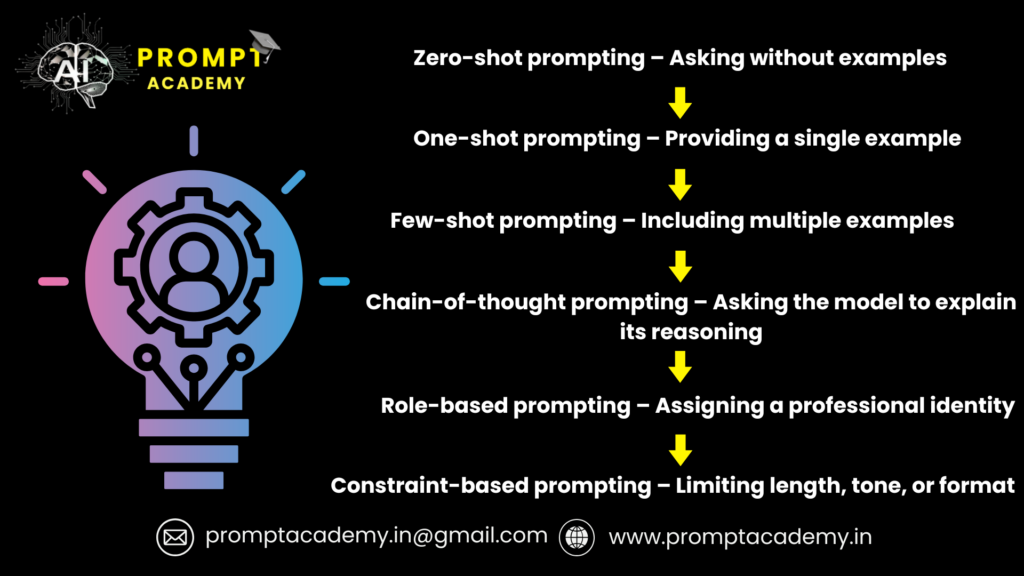
Some of the most effective techniques include:
- Zero-shot prompting – Asking without examples
- One-shot prompting – Providing a single example
- Few-shot prompting – Including multiple examples
- Chain-of-thought prompting – Asking the model to explain its reasoning
- Role-based prompting – Assigning a professional identity
- Constraint-based prompting – Limiting length, tone, or format
Each technique serves a specific purpose. Choosing the right one depends on the task, the audience, and the level of precision required.
Real-World Use Cases: Prompt Engineering vs Generative AI
The difference between prompt engineering and generative AI becomes most obvious in real-world applications.
In content creation, Generative AI writes text. Prompt engineering ensures the content matches brand voice, SEO requirements, and audience expectations.
In software development, Generative AI generates code. Prompt engineering defines architecture, language standards, and security constraints.
In data analysis, Generative AI summarizes insights. Prompt engineering ensures accuracy, context, and relevance.
Across industries, the pattern is the same: Generative AI executes, prompt engineering directs.
Benefits of Prompt Engineering
Prompt engineering delivers tangible benefits that directly impact productivity and quality.
Key advantages include:
- Improved accuracy
- Reduced hallucinations
- Faster workflows
- Better consistency
- Easier scaling across teams
Organizations that invest in prompt engineering see better ROI from their Generative AI tools. They spend less time correcting outputs and more time using them effectively.
Limitations of Prompt Engineering
Despite its value, prompt engineering has limitations. It depends heavily on the underlying AI model. A poorly trained model cannot be fixed entirely through prompts.
Other challenges include:
- Trial-and-error learning
- Lack of universal standards
- Model updates changing behavior.
Understanding these limitations is essential for realistic expectations in the prompt engineering vs generative AI debate.
Misconceptions Around Prompt Engineering vs Generative AI
One common myth is that better AI models eliminate the need for prompt engineering. In reality, more powerful models often require more precise prompts to unlock advanced capabilities.
Another misconception is that prompt engineering is “just common sense.” While basic prompts are simple, professional-grade prompt engineering requires structure, testing, and expertise.

The Role of Prompt Engineering Platforms
Prompt engineering platforms provide tools for managing prompts at scale. These platforms offer:
- Prompt version control
- Performance testing
- Collaboration features
- Optimization analytics
As AI adoption grows, platforms dedicated to prompt engineering will become as essential as code repositories are for software development.
The Future of Prompt Engineering and Generative AI
The future isn’t about choosing between prompt engineering and generative AI. It’s about deeper integration.
We’ll see:
- AI-assisted prompt creation
- Automated optimization
- Domain-specific prompt frameworks
Prompt engineering will evolve, but it won’t disappear. As long as AI systems require human intent, prompt engineering will remain critical.
Conclusion
The debate around prompt engineering vs generative AI misses the point when framed as a competition. Generative AI is the engine that creates. Prompt engineering is the discipline that directs creation toward meaningful outcomes.
Understanding both is no longer optional. It’s essential for anyone looking to work effectively with AI—today and in the future.
FAQ,s
1. Is prompt engineering the same as programming?
No, but it requires a similar logical mindset using natural language instead of code.
2. Can Generative AI work without prompt engineering?
Yes, but results are often inconsistent and unreliable
3. Will prompt engineering become obsolete?
Unlikely. As AI grows more complex, structured guidance becomes more important.
4. Do non-technical users need prompt engineering skills?
Yes. Even basic prompt knowledge improves results significantly.
5. Are prompt engineering platforms necessary?
For individuals, maybe not. For teams and enterprises, absolutely.